# Google Login

{% hint style="info" %}
To show the Google Login button in your apps, check out the **Enable Google Login Method** section in&#x20;

the link below.

<https://docs.notionapps.com/users/private-apps#enable-google-login-method>
{% endhint %}

{% hint style="warning" %}
This integration is not required to enable Google Login in your apps. This integration ensures that if you are using a custom domain, an intermediate link - <https://auth.notionapps.com> does not appear in the user login flow. This preserves your branding.
{% endhint %}

Once you've enabled Google Login for your apps, you can further customize the Google Login screen with your own branding. For this, you'll need to create your own Google project. Below is a step-by-step guide to do so:

## Create a Project (skip if already created)

1. Go to your Google Cloud Console - <https://console.cloud.google.com/apis/credentials>
2. Create a new project.

<figure><img src="/files/wSbE8nDjIjFDYF7ol36i" alt=""><figcaption></figcaption></figure>

3. Enter basic information about your app.

<figure><img src="/files/2GrWR7KFt0bbykng9JNA" alt=""><figcaption></figcaption></figure>

4. Select Audience as "External".
5. Enter your contact information.

<figure><img src="/files/ephNEDBTzFCoV7oqSWc0" alt=""><figcaption></figcaption></figure>

6. Click "Create" to finish creating your project.

<figure><img src="/files/A1hsp8wstbF5FCiRGakK" alt=""><figcaption></figcaption></figure>

## Create OAuth Client

1. Click on the "OAuth consent" OR the "+ Create Credentials" button.

<figure><img src="/files/msBJ1IxLL7bctnwINTy4" alt=""><figcaption></figcaption></figure>

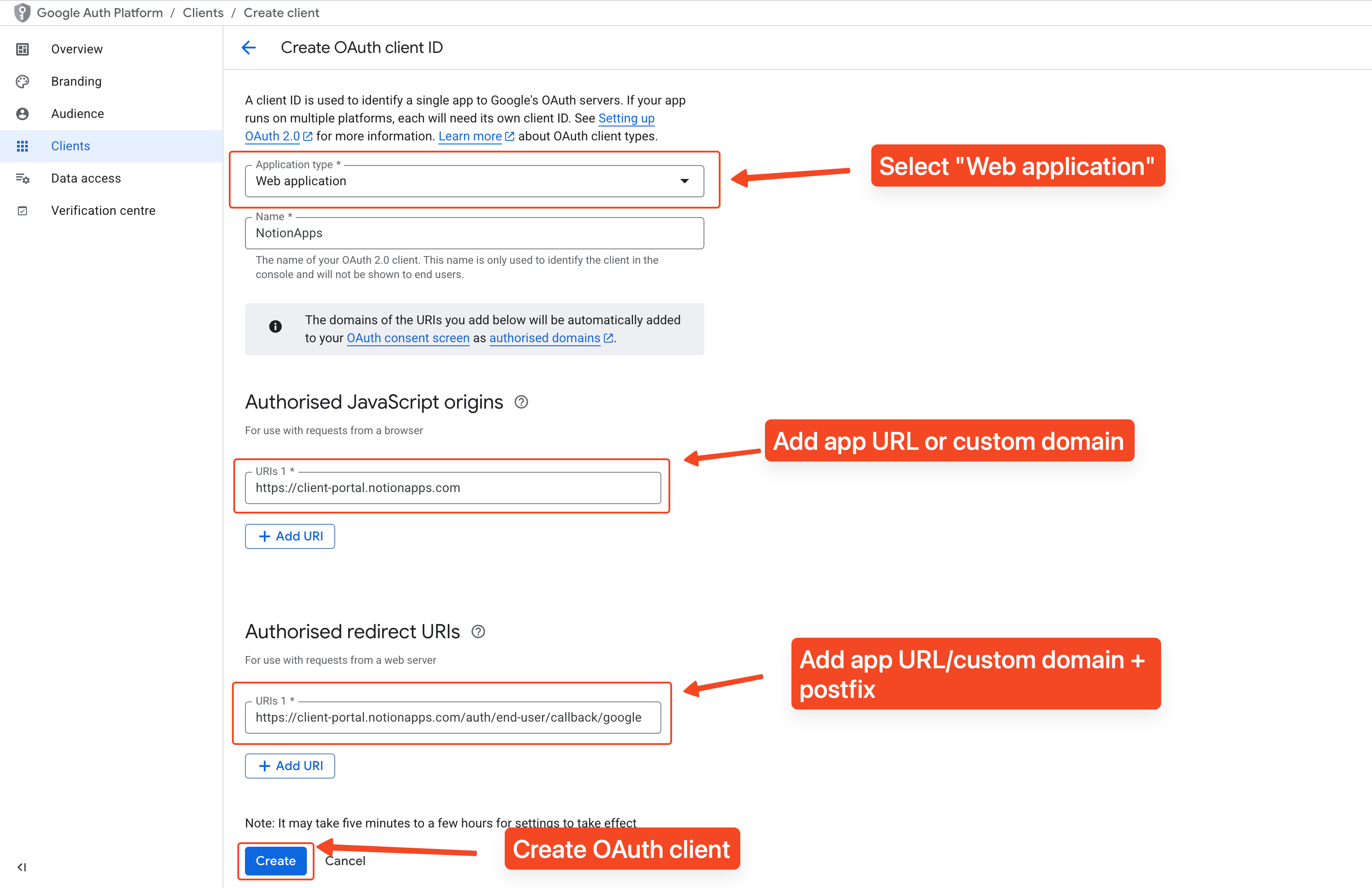
5\. Select Application Type as "Web application" and select an appropriate name of your choice

6\. Under "Authorised JavaScript origins", add your application URL like <https://example.notionapps.com>.<br>

{% hint style="info" %}
If your NotionApps' app is on a notionapps subdomain (e.g. example.notionapps.com), then you need to add "example.notionapps.com" as the authorized domain. If you've connected a custom domain (e.g. [yourdomain.com](http://yourdomain.com/)), just add your domain as it is.
{% endhint %}

7\. Under "Authorised redirect URIs", add your application URL with a postfix of "/auth/end-user/callback/google". For example, for client-portal.notionapps.com, add <https://client-portal.notionapps.com/auth/end-user/callback/google>.

8\. Click "Create"

<figure><img src="/files/3tOQ6Doqf3AwW83pEiQW" alt=""><figcaption></figcaption></figure>

9\. Copy the Client ID and Client Secret and add it to your Google Sign In Integration inside your application (you can create one in the new "Integrations" tab).&#x20;

<figure><img src="/files/nOU7N4E5duUuNTsPFBAn" alt=""><figcaption></figcaption></figure>

<figure><img src="/files/HDyp8ZdQxI0INEGXKaDc" alt=""><figcaption></figcaption></figure>

Now, you will see your own branding (company name) on the Google Login screen.


---

# Agent Instructions: Querying This Documentation

If you need additional information that is not directly available in this page, you can query the documentation dynamically by asking a question.

Perform an HTTP GET request on the current page URL with the `ask` query parameter:

```
GET https://docs.notionapps.com/integrations/google-login.md?ask=<question>
```

The question should be specific, self-contained, and written in natural language.
The response will contain a direct answer to the question and relevant excerpts and sources from the documentation.

Use this mechanism when the answer is not explicitly present in the current page, you need clarification or additional context, or you want to retrieve related documentation sections.